


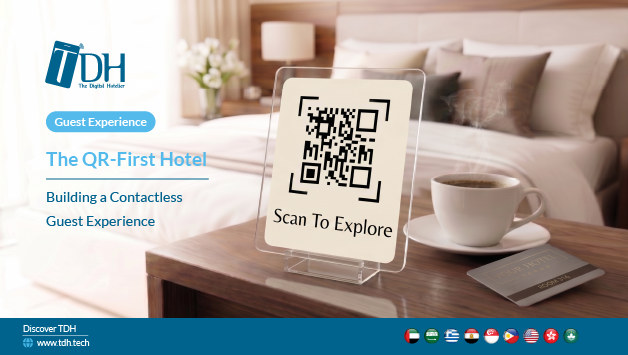
In short: A QR-first hotel uses QR codes as the main channel for guest services during the stay, not a backup to apps or phone calls. Each scan opens a context-aware service and sends the request to the responsible department. The result is faster service, less operational friction, and revenue captured at moments guests used to have to chase.
A guest settles into their room after a long journey. Instead of hunting through a printed directory or calling the front desk every time they need something, they scan one QR code and the hotel opens up. Food and drink ordering, housekeeping requests, spa bookings, local recommendations, service requests, all in their own language, with no phone call and no app to download.
This isn’t a frictionless future. It’s an operational decision a hotel can make today, and most still haven’t.
Guests want to get what they need fast, without a phone call and without learning anything new. The real question for an operator isn’t whether to offer that. It’s where to place the codes, what each one opens, and what happens after the scan.
What Is a QR-First Hotel?
A QR-first hotel is one where the QR code is the main channel between the guest and the property’s services during their stay, not a supplement to phone calls, room phones, or printed directories. Codes are placed across the property as context-aware entry points: the bedside code opens room dining and housekeeping, the poolside code opens drink orders, the spa code shows treatments and books them.
The word that matters is “main.” The term “contactless hotel” has been diluted to the point of meaning little. Most properties that call themselves contactless have added a QR code to a restaurant menu or installed a check-in kiosk. That is QR-enabled. The difference between the two isn’t the technology. It’s what the hotel makes the default channel.
QR-Enabled vs. QR-First
| QR-Enabled | QR-First |
| A QR code exists somewhere on the property. It opens a menu PDF or the hotel website. It is a bolt-on to a service model that still runs on phone calls and paper. | QR codes are the primary operational interface during the stay. Every touchpoint has a code calibrated to that location, and the platform behind them connects to operations. Requests are routed and tracked, not lost. |
Do Hotels Really Need an App, or Will QR Codes Do?
For most properties, QR codes are the better answer. A hotel app has to be downloaded, and a guest staying three nights once a year has little reason to install one and every reason not to. The budget spent building the app goes the same way: into a channel almost no one uses.
The QR-first model skips the download problem. The guest already has a camera. The hotel already has print surfaces. The technology is on both sides of the interaction. The work is structuring what happens after the scan. That is the gap The Digital Hotelier’s Guest-Journey was built to close: an app-free web platform where a guest scans one code and reaches the hotel’s services in their own language, no download required.
Where Should Hotels Place QR Codes?
The right code, in the right place, mapped to what the guest wants there.
A QR-first deployment is a placement map across the whole property, with each location matched to the services a guest needs in that spot. Two variables decide whether a code gets scanned: dwell time (does the guest pause here) and intent (do they want something here). The placements below are ordered by how reliably they pass both tests. One thing applies everywhere: the text beside each code carries the invitation, so a short call to action that names the benefit (“Order food and drinks to your sunbed”) reliably beats a bare code.
The Lobby
In the lobby the guest is orienting themselves. They want to know what’s on the property and how to reach it. A lobby code answers that before they’ve put their bags down, surfacing the digital guest directory and the services around them.
What to surface:
- The hotel directory: amenities, outlets, facilities, and opening hours at a glance
- Digital concierge and local area guides
- Wi-Fi credentials and a map of the property
Placement: Eye level at the front desk and on desk card stands, plus a code at the luggage point for guests waiting on a room. Lobby is where attention is split, so keep the code where the eye lands while waiting.
The Room
In the room the guest shifts from orienting to exploring. The bedside code becomes their main interface with the hotel, and one scan surfaces everything without picking up the phone.
This is consistently the highest-scan surface in any deployment, because the bedside is where the guest spends the most time, often without their wallet, usually with their phone already in hand. It is also where guest services requests start.
What to surface:
- Room dining and F&B ordering, routed straight to the kitchen with no telephone chain
- Housekeeping requests, maintenance reporting, and towel or amenity requests in one tap
- Restaurant and spa booking, handled from the room
- Personalised upsell offers and add-ons surfaced during the stay
- In-stay feedback, so guests flag an issue while it can still be fixed instead of writing it in a public review afterwards
Placement: Bedside table card, TV surround panel, door hanger, minibar top. High-dwell spots where the guest naturally pauses.
The Pool
The poolside guest is in the highest-impulse state of the whole stay: relaxed, settled, and unlikely to move. Any service that requires standing up and walking to a desk is a service that mostly goes unrequested. A poolside code turns that inertia into an order.
What to surface:
- F&B ordering, drinks and snacks delivered to the sunbed without the guest moving
- Towel requests, amenity requests, and guest services in one tap
- Restaurant and spa booking, reserved from the pool
Placement: Sunbed tags, poolside menu stands, umbrella poles. Specify the material before printing. Standard paper codes degrade in chlorine, sun, and humidity within weeks, so use laminated or laser-etched formats that survive a full season.
The Spa
The spa has two commercially distinct moments. Before a treatment the guest is anticipating, and receptive to add-ons and upgrades. After it they are calm and satisfied, which is the best moment in the stay to capture a review or prompt another booking.
What to surface:
- Treatment booking, scheduled directly through the booking module
- Upsell offers, spa packages, and add-on treatments
- A review prompt, surfaced at the post-treatment peak before the moment passes
Placement: Reception desk, treatment menus in the relaxation area, and the changing-room mirror card. Keep codes out of the treatment room itself, where the guest is meant to disconnect.
The Restaurant
Restaurant QR is the most mature segment of this space. Guests already expect it, and most full-service restaurants already use QR menus, which makes paper-only the minority format now. The opportunity here is to go past the menu into ordering and feedback.
What to surface:
- Visual menus with full ordering, routed straight to the kitchen or bar
- Table booking, so a guest at the pool or in their room can reserve dinner
- Upsell at the point of order, meal deals and pairing suggestions
- In-stay feedback, so a service issue gets flagged during the meal and recovered before the guest leaves
Placement: Every table, the host stand, and the bar counter. A table tent with a short CTA such as “Order and pay from your phone” earns the highest scan rates.
What Happens After the Guest Scans?
This is the part most QR articles skip, and it’s the part that decides whether a deployment works. A scan is the guest’s signal. The real work starts on the other side of it.
In a working QR-first system, every scan creates a request that goes to the team that owns it. A poolside drink order reaches the pool bar with the sunbed number attached. A maintenance request reaches the engineering team with the room number and the issue, and a photo if the guest added one. A spa booking checks availability, holds the slot, and notifies the therapist. None of it asks the guest to know which department handles what, and none of it needs a front-desk callback.
This is where Guest-Journey connects to TeamStream+. The guest sees one interface. The operation sees each request land with the right team, tracked through to completion. When you evaluate any QR-first platform, the question isn’t “does it open a menu.” It’s where the request lands, who owns it, and what happens if no one picks it up. A QR code that opens a PDF can’t answer that. A QR-first system has to.
What Hoteliers Say
“
The QR code platform is very easy for guests to use, allowing them to navigate and instantly access everything they might need. What really stands out is its availability in multiple languages. With such a diverse clientele, this makes the experience far more comfortable and inclusive for our guests.
Nitesh Mahabirsingh, Food & Beverage Manager, Grand Millennium Dubai
What’s the ROI of a QR-First Hotel?
A QR-first deployment moves three numbers on a hotel P&L: what it costs to serve a guest, how much each guest spends, and how the property scores on reviews. For a deeper view of the revenue side, see how digital service connects to driving more hotel revenue. Here’s how each one shifts.
1. Lower cost to serve
Labour is the single largest cost in a hotel’s F&B department. CBRE Hotels Research found labour made up 59.4% of total F&B department expenses for U.S. hotels in the first half of 2025, ahead of cost of goods sold (24.0%) and everything else (16.6%). When order capture moves from a phone call to a guest-completed scan, the labour cost attached to taking each order drops, and order accuracy rises because the guest entered it themselves.
The wider labour picture is the reason this matters. The American Hotel & Lodging Association projected U.S. hotels would pay a record $128.47 billion in wages, salaries, and compensation in 2025, up from $125.79 billion in 2024, while 64.9% of operators reported they were still short-staffed. Every routine task a guest can complete themselves is one a stretched team no longer has to.
- Printed menus, directories, and request cards collapse into one updatable QR, removing recurring print costs and the work of keeping static materials current
- Staff are freed from transactional interruptions and redeployed to service recovery and the hospitality guests actually remember
- Digital F&B orders route straight to the kitchen or bar, removing the telephone chain that is the main source of fulfilment errors and re-sends
2. Higher guest spend
With room revenue close to flat, ancillary spend is where margin growth is happening. CBRE, analysing operating statements from 2,669 U.S. full-service, resort, and convention hotels, found F&B revenue per occupied room grew 3.8% in the first half of 2025, outpacing total hotel revenue growth of 3.0%, while F&B profit margins improved from 28.7% to 29.1%. Looking ahead, PwC forecasts U.S. hotel RevPAR rising just 0.9% in 2026, which is exactly why F&B, not rooms, is where operators are chasing growth.
The mechanism is concrete. A guest on a sunbed orders a drink without moving. A guest in a robe orders dinner without calling room service. A guest at a table orders a second course without waiting for a server to pass. Each of those is F&B revenue that is either captured or lost, decided entirely by how easy the property made it to order.
- Poolside, in-room, and restaurant ordering captures impulse spend that disappears when the friction is too high: the walk to the bar, the unanswered phone, the server who isn’t passing at the right moment
- A visual, well-structured menu drives discovery spend, because guests order what they can see rather than only what they remember to ask for
3. Better reviews, more repeat business
Faster, lower-friction service shows up directly in reviews. Shiji’s 2026 Guest Experience Benchmark, published January 2026 and drawing on more than 40 million guest reviews across 12,000 hotels in eight regions, recorded a global guest satisfaction score of 86.7% in 2025, up 0.5 points year over year, with review volume up 2.1%. Its central finding: hotels that reduced friction through technology and responsive service pulled ahead of those that didn’t, and the gap widened across every region.
- In-stay feedback lets a guest raise an issue while they’re still on the property, routed to the responsible team, heading off the public review that no later response can undo
- A review prompt at a peak moment, just after a meal or a treatment, tends to land better than a generic email after the guest has left
- Faster service across ordering, housekeeping, and maintenance removes the friction that drives negative reviews in the first place
REVENUE STREAMS IN PRACTICE
“
Implementing The Digital Hotelier at LEVA Hotel has opened up new revenue streams for us. By integrating external services like taxi bookings, car rentals, and pharmacies, we are able to offer our guests a more comprehensive experience.
JS Anand, Founder, LEVA Hotels
What Should Hotels Ask a QR-First Vendor?
Before committing to any platform, a handful of questions separate a real QR-first system from a glorified menu link. These are the ones worth asking on the demo call, of any vendor, TDH included.
- Where does the request land after the scan? A specific department, or a generic inbox someone has to remember to check?
- How many languages does it support natively? A true native-language interface is not the same as a translate button bolted onto an English page.
- How fast can the menu be updated, and by whom? Daily kitchen changes need same-day updates the hotel can make itself. If every change goes through the vendor, the content will drift out of date.
- Does it cover the whole property or just rooms and restaurants? A QR-first deployment is lobby, room, pool, spa, restaurant, and the shared spaces in between, not two placements.
- Which payment methods and gateways are supported? Local payment methods matter across the Gulf, the Americas, and Southeast Asia. Guest-Journey supports Magnati, iOL Pay, Telr, Shift4, Paymongo, Stripe, and Xendit.
- How does it connect to the team that fulfils the request? A guest platform that routes into a real operations system gets requests done; one that routes nowhere just collects them.
A vendor that gets vague on any of these is showing you where the deployment will fall short later.
Why Do Hotel QR Deployments Fail?
Most underperform, and usually in one of a handful of predictable ways. The governing principle behind all of them: contactless should remove friction, not add it. A deployment that produces broken links, poor mobile pages, forced downloads, or stale content is worse than none, because it carries the promise of convenience without keeping it.
Technical failures
- A broken link. A guest who hits a 404 on day one will not scan again for the rest of the stay.
- Slow or desktop-formatted pages. A scan that loads a page needing pinch-and-zoom is a failed scan.
- Forcing an app download after the scan. The most common and most avoidable way to defeat the whole point of going contactless.
- Static codes that can’t be updated, so the content drifts out of date as menus and prices change.
Operational failures
- Wrong placement. Codes on walls no one looks at, or in spots with no dwell time.
- Ignoring multilingual guests. A single-language QR strips out the accessibility advantage in any international property.
- No measurement. Without scan and completion rates by touchpoint, there is nothing to optimise.
- No human fallback. QR-first does not mean QR-only. There must always be a one-tap way to reach a real staff member, for the guest without data roaming, the guest who finds the code hard to read, or the request that is genuinely complex. Strip that out and the system becomes a barrier instead of a service.
Are QR Codes Safe for Hotel Guests?
QR codes are safe for guests when the hotel controls the destination and the physical code can’t be swapped. The risk is real: fraudsters stick fake codes over genuine ones to redirect guests to phishing or fake-payment pages, a category security teams call “quishing.” Hotel guests are a known target, because they’re in an unfamiliar place and tend to assume any code on the property is legitimate.
The defence is mostly operational, not technical:
- Use tamper-evident or laser-etched surfaces, never peelable stickers that can be covered
- Print the hotel name and the service on every code, so a guest can verify the destination before acting
- Train front-of-house to recognise and report a tampered or overlaid code the same shift, especially in the lobby and restaurant
- Resolve every service through one branded HTTPS domain, never a third-party short link, so guests learn what the real URL looks like
A property with codes on every surface needs a codes-on-every-surface security policy. It is a small amount of operational discipline that protects both the guest and the property’s reputation.
Frequently Asked Questions
How much does a QR-first guest experience cost a hotel to run?
Most QR-first platforms are sold as a subscription rather than a per-scan charge, so the running cost is largely fixed regardless of how many guests use it. Against that, the property removes recurring print costs for menus and directories, and shifts routine order-taking off staff time. The cost question is better framed as cost-to-serve: the platform fee against the staff hours and print spend it removes.
Does a QR-first system work for guests who don’t speak the local language?
That’s one of its biggest advantages over a printed directory or a phone call. A native multilingual platform lets a guest read the menu and place a request in their own language, which a paper menu in one or two languages cannot. For international and resort properties, this is often the single feature guests mention most. Guest-Journey supports seven or more languages for this reason.
What happens if a guest doesn’t want to use their phone?
A QR-first hotel should never be QR-only. The front desk and the phone stay available for guests who prefer them, for accessibility needs, or for complex requests. QR-first means the QR is the default fast path for the majority, not the only door. A deployment that removes the human option entirely has misunderstood the model.
Who installs and manages the QR codes across the property?
The platform provider supplies the codes and the system behind them; the hotel decides placement and prints to the right materials for each location. Day-to-day management, updating a menu, changing an offer, adding a service, is done by the hotel team through the platform, not through the vendor, which is what keeps content current.
One Code, Every Touchpoint
The QR-first model isn’t a technology project. It’s an operational decision about where friction lives in the guest experience, and a commitment to removing it across every touchpoint where a guest reaches for their phone instead of the hotel.
Guests reward hotels that make service easy to reach, and they punish the ones that don’t. The tool for delivering that ease is already in the guest’s hand. The QR code is how a property activates it.
The hotels that lead on guest experience over the next few years won’t be the ones that spent the most on technology. They’ll be the ones that picked the right placements, wrote CTAs guests actually scan, and made sure every scan reaches a real person behind the screen.
See It on Your Property
The clearest way to understand a QR-first deployment is to see one mapped to your own property. Book a demo of Guest-Journey and we’ll walk through what each placement opens, in your guests’ languages, and how every scan reaches the team that fulfils it.
Sources Referenced
Oracle Hospitality & Skift, Hospitality in 2025: Automated, Intelligent… And More Personal (self-service and contactless figures; global, survey fielded spring 2022). oracle.com
CBRE Hotels Research, Hotel Food and Beverage – A Bright Spot in 2025 (F&B labour share, F&B revenue per occupied room, profit margins; U.S., November 2025). cbre.com
PwC, US Hospitality Directions (2026 RevPAR forecast; U.S., December 2025). pwc.com
American Hotel & Lodging Association, 2025 State of the Industry Report (wages and compensation, staffing challenges; U.S., 2025). ahla.com
Shiji, 2026 Guest Experience Benchmark (global guest satisfaction, review volume; global, published January 2026). shijigroup.com