



In short: Hotel preventive maintenance software converts a scheduled checklist into a running, assigned, documented program. Each task carries a frequency, a named owner, a procedure, and a timestamped completion record. In hotels, it works best when it lives inside the same platform that handles reactive maintenance, housekeeping, and guest requests, because that is where most maintenance signals actually originate.
Hotel maintenance department costs rose 5.0% in 2024, outpacing total hotel revenue growth of 2.3%, according to CBRE Hotels Research. The pressure is not going away.
But the gap between properties that absorb that pressure and those that do not often comes down to a single operational question: how structured is the maintenance program, and how well does the software support it?
Most hotel maintenance software looks identical on a feature sheet. Work orders, preventive scheduling, asset tracking, mobile access, dashboards. The real differences show up six months into the operation, when the system has to survive occupied rooms, rotating shifts, and maintenance signals arriving from three different directions at once.
This guide is for the maintenance manager, engineering manager, or operations leader who has decided that paper logs and spreadsheets will not hold, and now needs to choose the right system.
Why Hotels Are a Different Maintenance Environment
Hotels have one structural disadvantage that most other building types do not: there is no window during which the property empties out. A factory can schedule downtime. An office building clears out on weekends.
A hotel runs 24 hours a day, 365 days a year, with guests in occupied rooms at almost all times.
That single constraint changes the maintenance calculus in three specific ways.
Maintenance signals come from multiple directions. A housekeeper notices a dripping fitting during a room turnover. A guest calls the front desk about a rattling AC unit. A technician spots a pool pump pressure drop on the morning round. A system that only accepts work orders from the engineering team is already missing most of what is happening across the property.
Documentation has to hold up under audit. Hotels operate under fire, electrical, pool, elevator, and food hygiene codes that vary by jurisdiction and local regulatory authority. When an inspector asks for evidence of a specific past inspection, the record needs to be retrievable in seconds, not assembled from binders or exported spreadsheets.
The cost of failure is immediate and visible. In a warehouse, a breakdown delays a shipment. In a hotel, it happens in front of a paying guest, and the record of that moment can follow the property for months.
What Hotel PM Software Actually Does
Hotel preventive maintenance software does four things consistently:
- Schedules recurring inspection and service tasks at the correct frequency for each system
- Assigns each task to a named role or individual, so completion is traceable
- Records completion with a timestamp, the person responsible, and supporting documentation, whether that is a note, a photo, a PDF, or a video file
- Surfaces what is overdue, what is complete, and what patterns are developing across the property
A system that cannot do all four consistently is a reminder tool, not a PM program.
The Features That Actually Matter
Vendor demos show capability breadth. These are the features that determine whether a PM program runs in practice.
| Feature | What to Verify |
| Frequency range | Can you schedule a daily checklist at 7:00 AM, and a separate monthly one on the 2nd of each month? NFPA 110 requires weekly no-load generator runs and monthly load tests. NFPA 25 requires weekly visual gauge checks on dry pipe valves. A system that only supports daily or monthly cycles cannot carry a real hotel PM program. |
| Per-task ownership | Can individual tasks within one checklist be assigned to different people? A single HVAC round may involve a technician for filters, a plumber for condensate drains, and a supervisor for sign-off. |
| Inspection layer | Is there a configurable sign-off step per checklist, with a defined inspector role? Compliance-critical tasks need a second set of eyes before the record closes. Routine daily rounds do not. |
| Mobile execution | Is the mobile app the primary working surface, or a stripped-down version of the desktop? Engineering teams work on their feet. |
| Scope control | Can a checklist be targeted to specific floors, rooms, or service areas? A pool PM round covers different zones from a guest room round. |
| Audit retrieval | How many clicks to retrieve a specific completed round from six months ago? If the answer involves exporting anything, the system will cost you exactly when audit response matters most. |
| Multi-source maintenance | Do guest-submitted and housekeeping-submitted maintenance reports live in the same system as the PM program? |
Paper, Spreadsheets, Standalone CMMS, and Connected Operations Platforms
| Capability | Paper | Spreadsheet | Standalone CMMS | Connected Platform |
| Recurring PM scheduling | Manual calendar | Manual reminders | Automated | Automated |
| Per-task ownership | Name on a sheet | Cell-level | Native | Native |
| Inspection sign-off | Initials | Manual second column | Configurable | Configurable |
| Time-of-day scheduling | No | No | Varies | Supported |
| Mobile execution | Print and walk | Not designed for it | App-based | Mobile-first |
| Task-level documentation | Initials or nothing | Cell notes | Notes and photos | Notes, photos, PDFs, video files |
| Maintenance from housekeeping | Verbal or in-person | WhatsApp, email | Separate channel | Same platform |
| Maintenance from guests | Front desk handoff | Lost in chain | Separate channel | Same platform |
| Audit retrieval | Filing cabinet | File search | Reports module | Live, queryable by round, printable, with mobile activity log per person |
| AI pattern analysis | Not possible | Manual | Reporting tools | Live data with AI layer |
| Scales past 100 rooms | Breaks down | Breaks down | Yes | Yes |
The practical distinction is between the last two columns. A standalone CMMS solves the PM problem in isolation. A connected operations platform solves it inside the rest of the hotel operation, which is where most maintenance problems first appear.
Six Questions to Ask Before You Sign
Software demos are designed to show capability. These questions reveal operational fit.
- How long does it take a new technician to complete a work order without help?
According to U.S. Bureau of Labor Statistics Job Openings and Labor Turnover data, leisure and hospitality averaged approximately 5% monthly separations throughout 2024, the highest rate of any sector. Engineering and maintenance roles are consistently among the harder positions to fill. A system that takes days of training before someone is productive works directly against the operation. - Can individual tasks within one checklist be assigned to different people?
In real hotel operations, a single PM checklist covers multiple disciplines. All-or-nothing assignment is a paper-era limitation dressed in software. - Is the inspection step configurable per checklist, or does it apply to everything?
Compliance-critical tasks need sign-off. Routine daily rounds do not. A system that forces the same workflow on every task creates friction that leads to workarounds, which eventually means incomplete records. - Do PM and reactive maintenance share the same system?
When the same asset generates a scheduled PM round and a reactive report in the same week, the engineering manager should see both in one view. If they live in different systems, making that connection requires manual effort that rarely happens under shift pressure. The connection matters at the task level too. When a technician flags an issue during a PM round, the system should allow them to convert that flag into a tracked service request on the spot, without switching tools or waiting to report back at the end of the shift. - How do you retrieve a specific completed inspection from six months ago?
If the answer involves exporting data, searching a folder, or calling support, the audit response will cost you time and credibility exactly when those are most critical. - Does the mobile app match the desktop experience?
A stripped-down mobile app signals that the product was built for desk-based managers and adapted for field use as an afterthought. In practice, full mobile functionality means a technician opens a task on the phone, reads the procedure, views any attached diagrams or instructional videos, marks each step complete or flags an issue with a photo, converts that flag to a service request, and closes the round. No desktop required at any point.
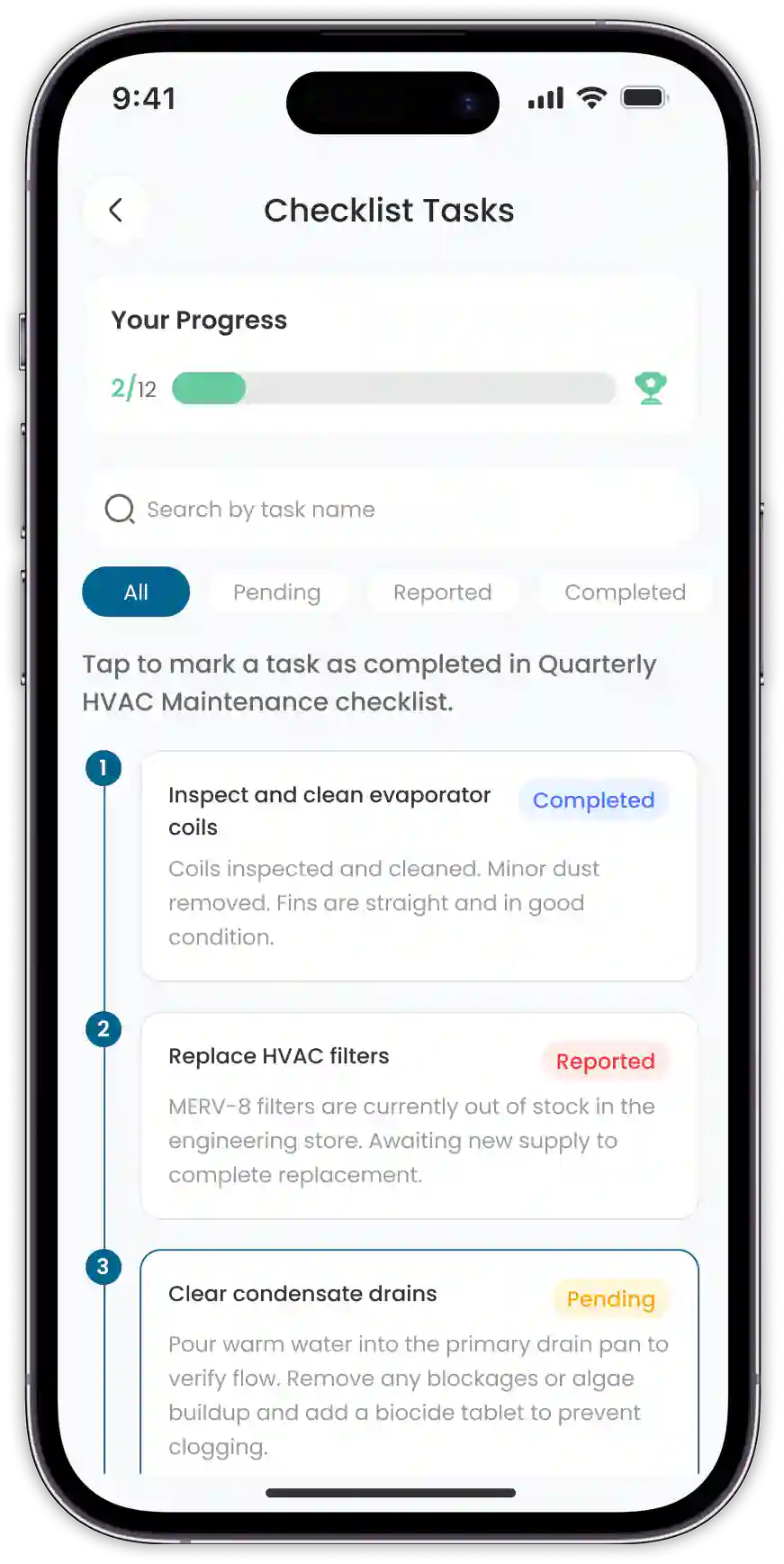
Mobile execution view for technicians to easily update task statuses and add real-time notes during PM rounds.
How TeamStream+ Handles Preventive Maintenance
TeamStream+ is The Digital Hotelier‘s hotel operations platform. Preventive maintenance runs inside it alongside reactive maintenance, housekeeping, service requests, guest complaints, meter readings, and team communication.
PM is not the headline feature. It works because everything else is on the same platform.
Building and Running PM Checklists
Digital Checklists serves as the core hotel checklist software where PM programs are configured. A manager creates a checklist with a name, assigns it to a role or to named users, selects a department, and sets the frequency: daily at one or more specific times within the day, weekly on selected days of the week, monthly on selected dates, or yearly on selected months and dates. Three optional configuration toggles control scope and oversight:
- Need an Inspection: activates a sign-off step and defines which roles can inspect
- Include Rooms: targets the checklist to specific floors and rooms
- Include Service Areas: targets by location category, location, and service area
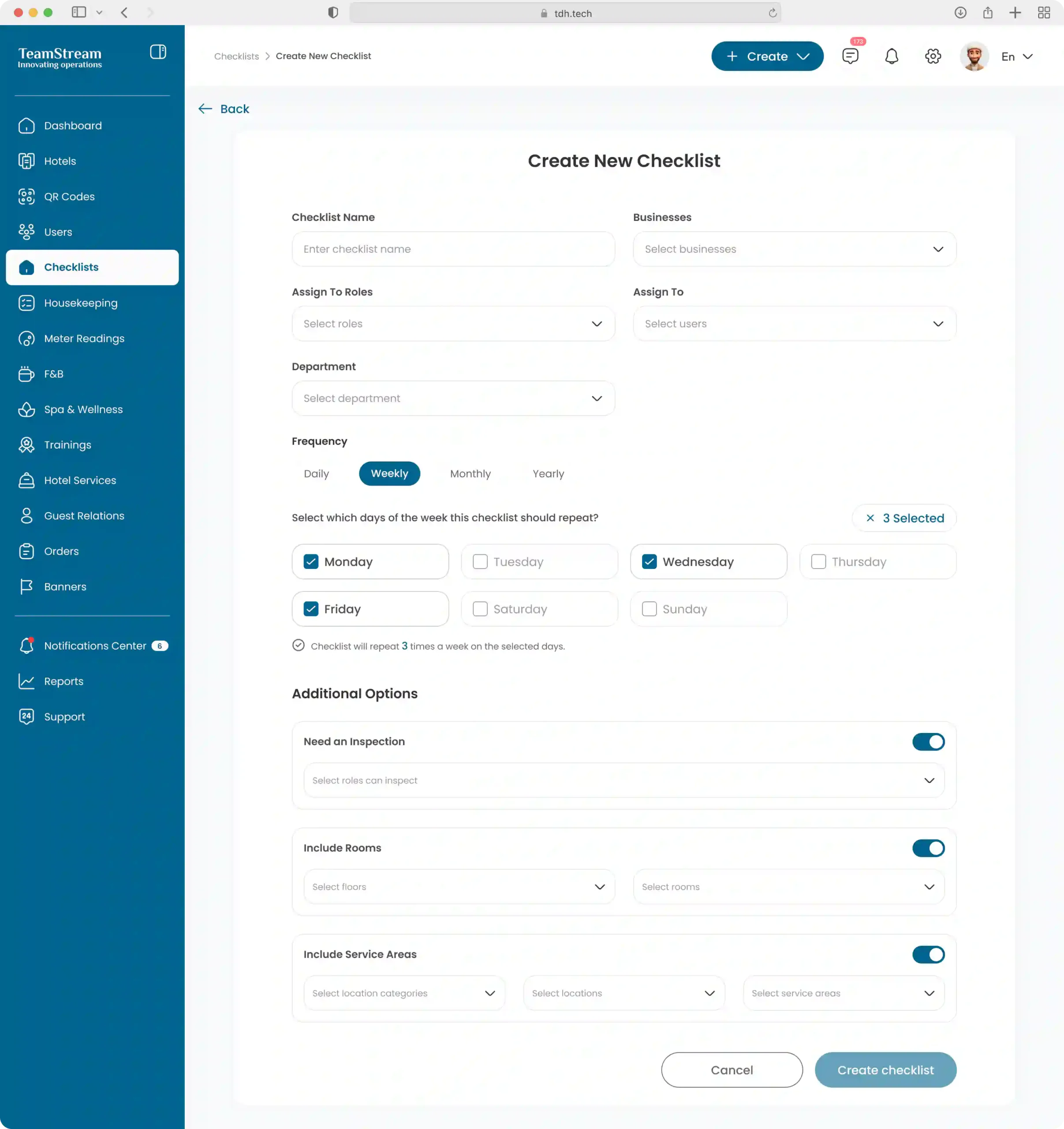
Centralized dashboard for creating checklists, defining automated schedules, and assigning inspector roles.
Tasks within a checklist are each configured individually. Each task can be assigned to a different person, can carry a description with supporting detail and a standard completion time, and can include optional file attachments — photos, PDFs, or video files — for tasks where the technician needs reference material in the field.
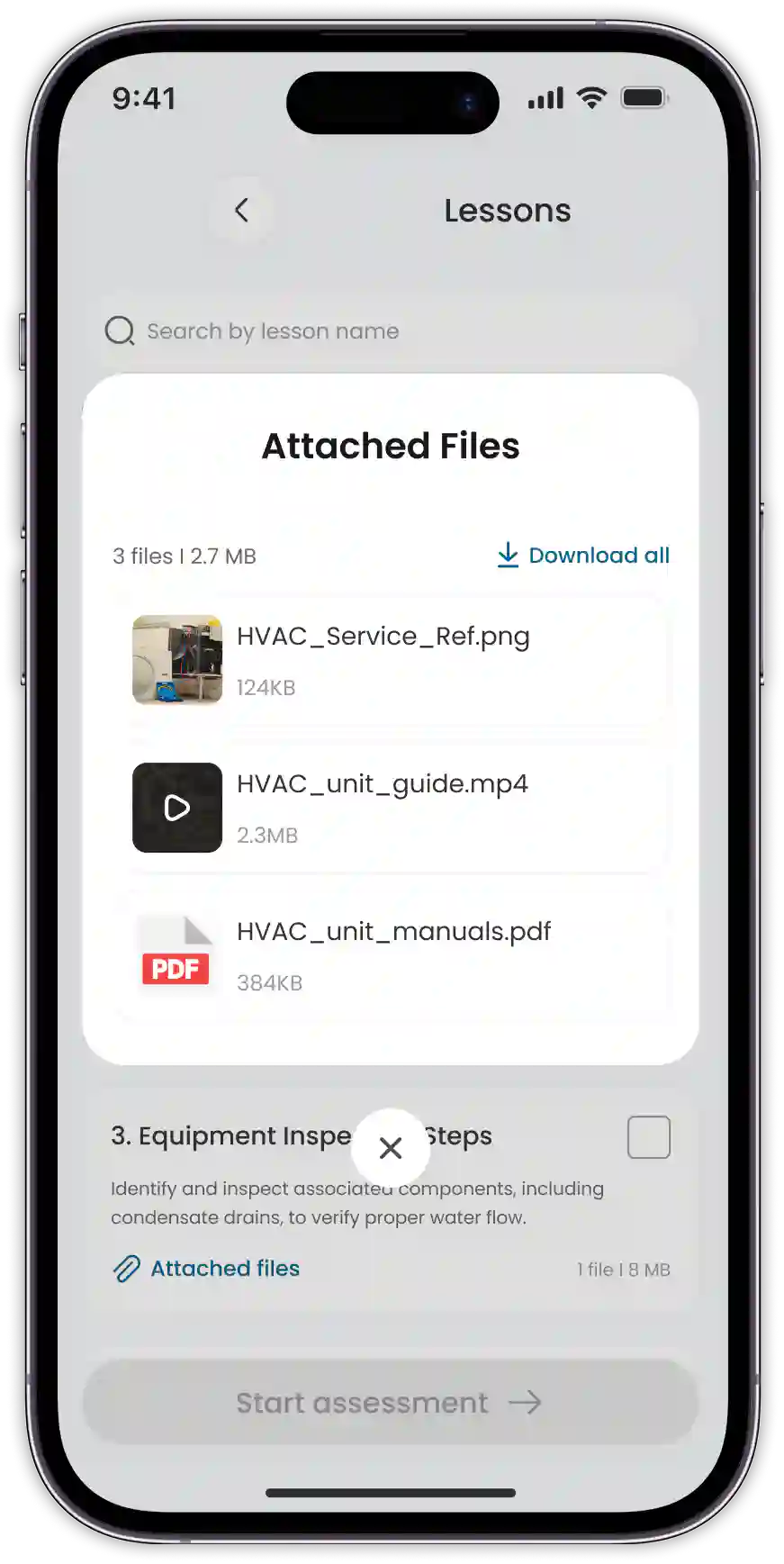
Instant access to SOPs, video guides, and reference photos directly within the specific task view.
Each task closes with one of two outcomes: Completed, meaning the check passed, or Reported, meaning the technician found an issue requiring follow-up. That distinction is what connects the PM round directly to the reactive maintenance workflow.
One checklist can span multiple team members and areas, with every task attributable to a named individual.
For situations that fall outside the normal schedule, the mobile app includes a persistent Start an Audit button. If a technician notices something irregular during an unrelated task, they can trigger a checklist immediately without waiting for the next scheduled round. The resulting record carries the same timestamped attribution as any planned inspection.
Keeping the Team Ready to Execute
A PM program is only as reliable as the people running it. In a sector where engineering roles turn over at some of the highest rates of any industry, new technicians need to get up to speed quickly and execute correctly from the start.
TeamStream+ includes a hotel staff training software that allows engineering managers to build role-specific training courses tied to their PM program.
A course covering an HVAC filter replacement procedure, for example, can include step-by-step lesson text, detailed PDF manuals, and instructional videos designed specifically for onboarding.
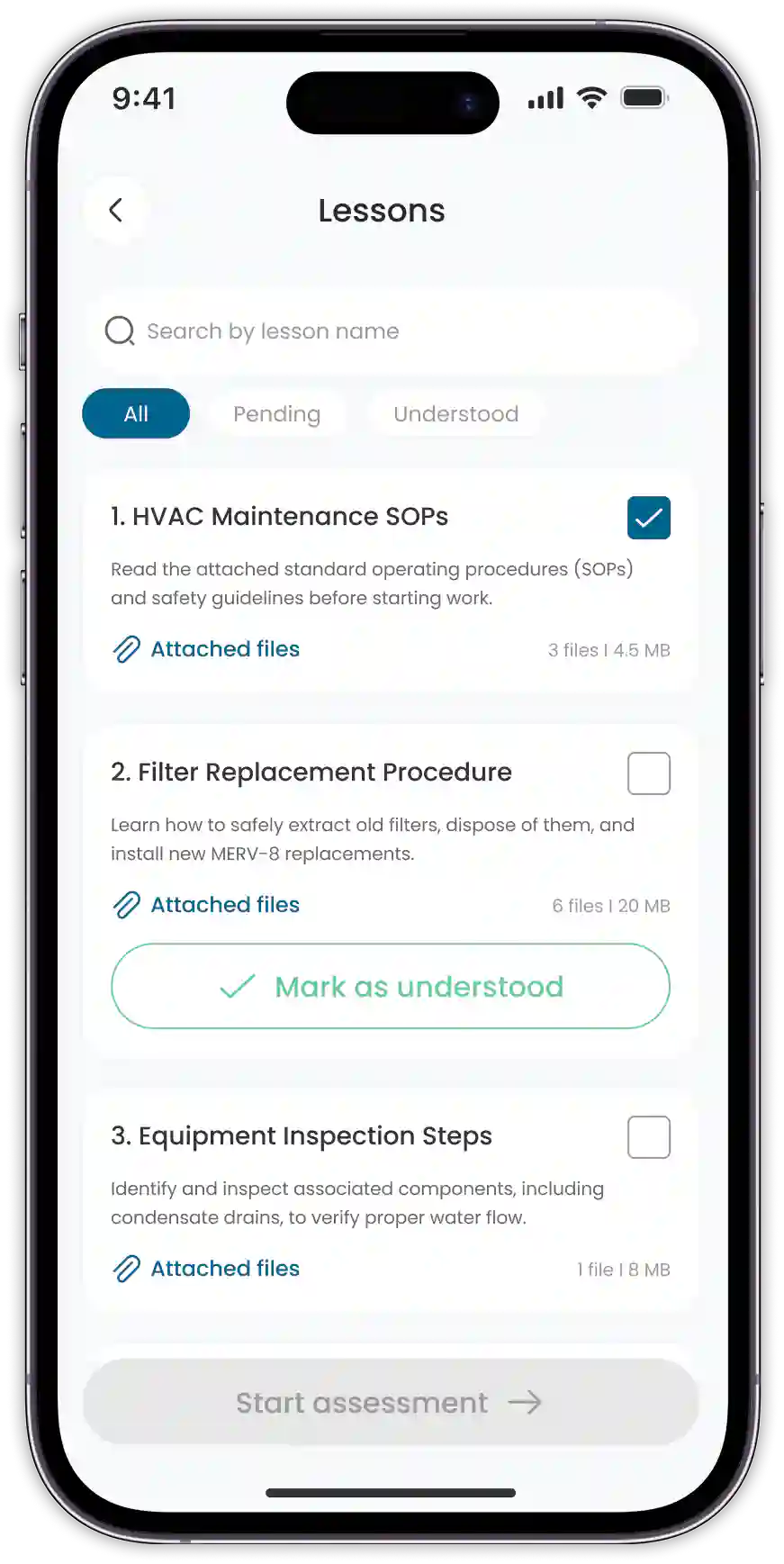
Structured mobile training modules requiring staff to review all lessons before taking the final assessment.
Technicians read through the material on their phone, confirm each lesson, and pass a scored assessment before they are cleared to work on specific equipment.
The manager sees progress in real time: who has completed the training, who is overdue, and what score each technician achieved.
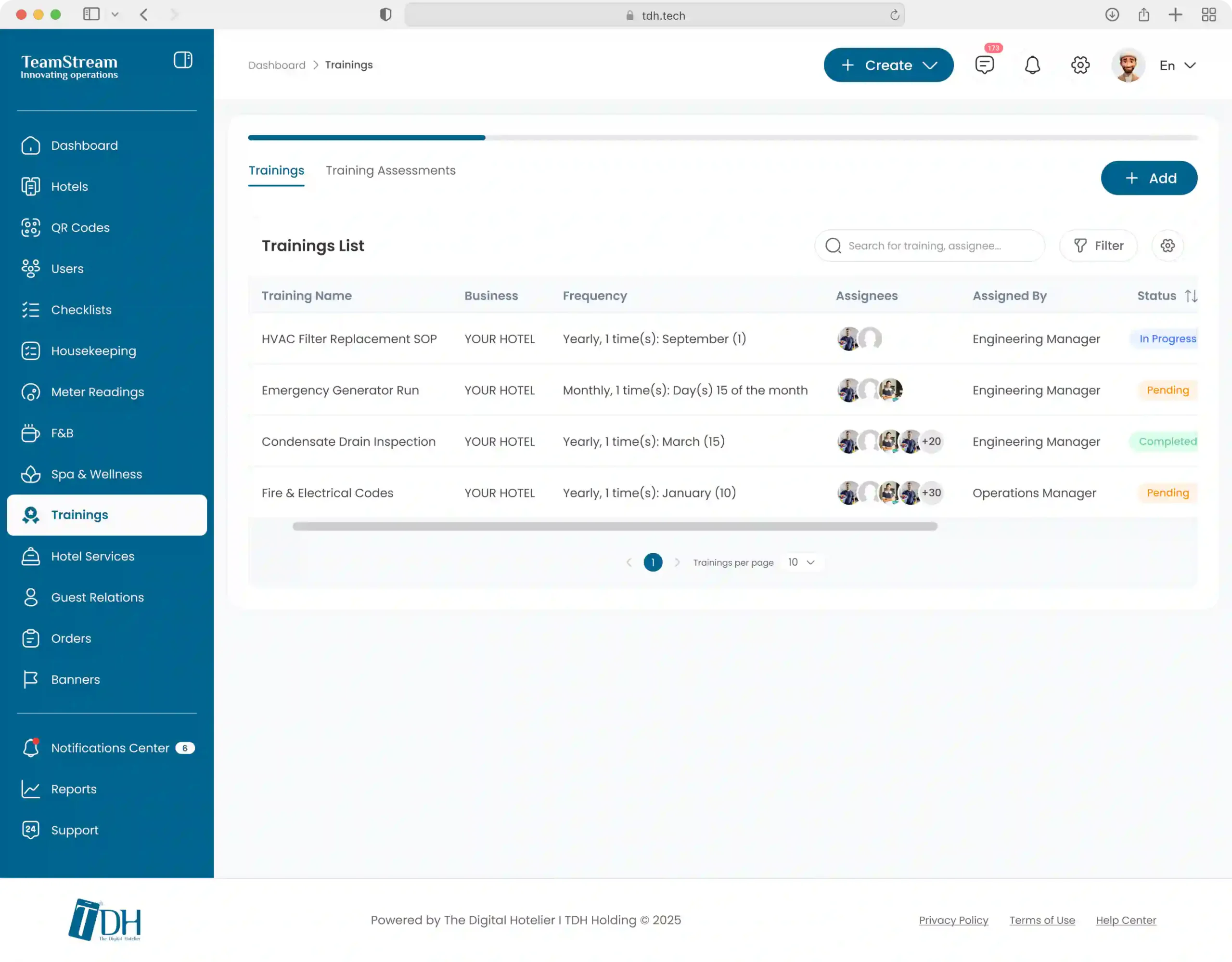
Real-time manager dashboard to track staff training progress and compliance schedules.
The completion record is timestamped and retrievable, which matters when a compliance question involves not just whether a task was done, but whether the person who did it was trained to do it.
The training content is fully customizable. Hotels build it from their own SOPs, adapted to the specific systems, equipment, and regulatory requirements of their property and region.
Reactive Maintenance on the Same Platform
Reactive maintenance requests reach TeamStream+ from three sources: staff members using the app, your hotel housekeeping software during room operations, and guests through Guest-Journey.
Each report creates a tracked work order with categorized details and photo attachments where provided.
The engineering manager sees both PM rounds and reactive tickets in the same system. When the same asset generates a scheduled PM round and a reactive report in the same week, both are visible.
Whether to reprioritize the PM task or expedite the reactive repair remains the manager’s decision. The system provides the visibility, not the answer.
At the task level, the connection is more direct. When a technician marks a PM task as Reported during a round, the system immediately prompts them to create a service request for it on the spot. The PM record and the reactive ticket are linked from the moment the issue is logged, without any manual handoff required.
Checklist Reports and OptemAi
Each completed checklist round produces a full report: who inspected, start and end times, generated time, and a line-by-line view of every task with its status, notes, and any attached files. For multi-floor properties, tasks are grouped by physical building level within the report, so an auditor reads the record the same way they would walk the property.
The report is printable directly from the dashboard. When an inspector arrives on-site and needs documentation on paper in thirty seconds, that button matters. The same data is also accessible on mobile as a timestamped activity log per person, who completed which task, at what exact minute, with any attached evidence, filterable by date range.
Each report includes an OptemAi Analysis that generates Key Findings, Recommendations, and Risk Alerts from the actual round data.
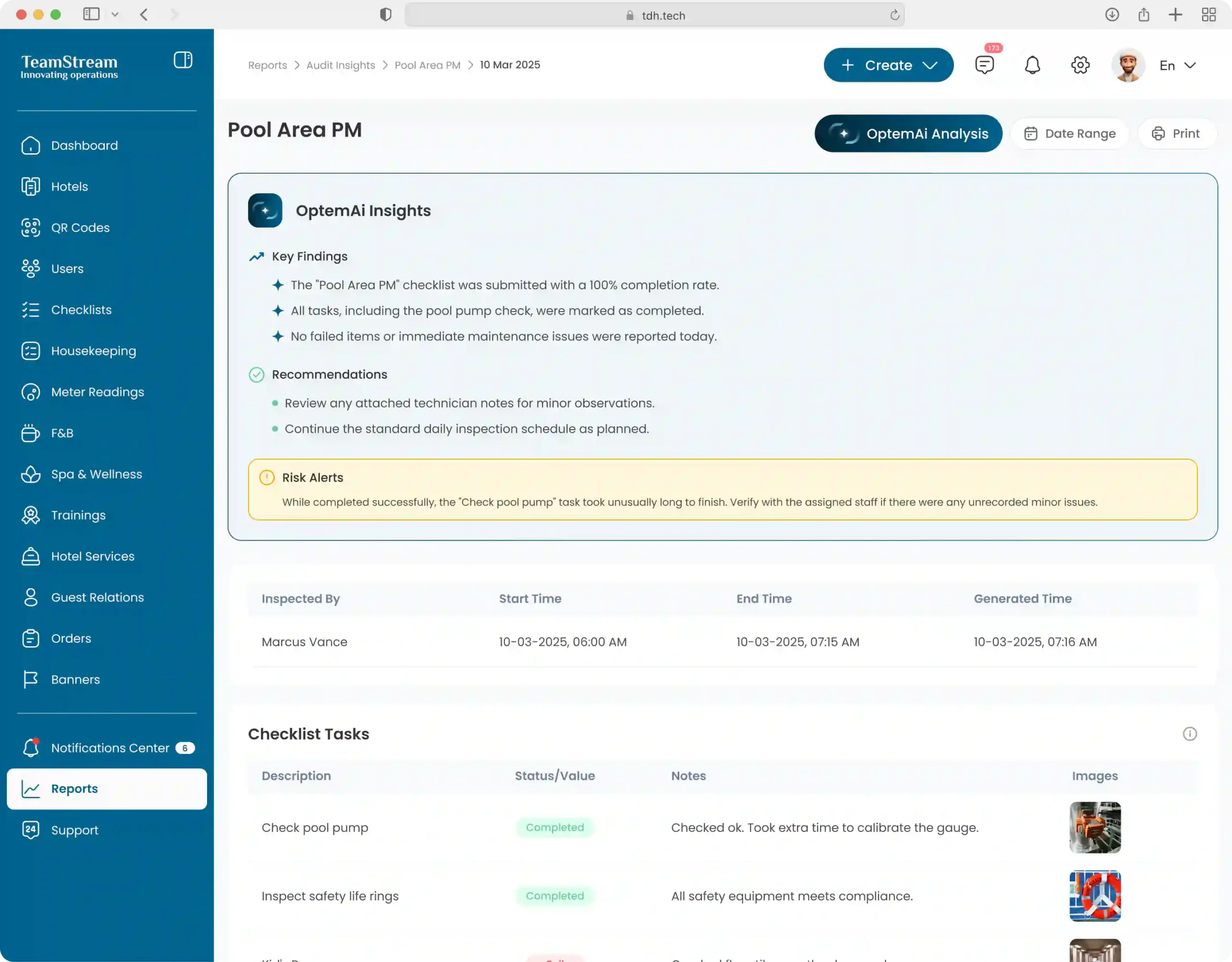
OptemAi analyzes checklist report to provide actionable recommendations and highlight hidden operational risks.
OptemAi also runs as a chat module inside TeamStream+, giving managers direct query access to live operational data.
Instead of exporting a report, a manager asks “Which checklists had tasks marked as Reported this week?” and gets a direct answer from the system’s data.
For the reactive maintenance side specifically, see our hotel maintenance management software feature. For the broader platform, TeamStream+.
Frequently Asked Questions
What is the difference between a generic CMMS and hotel preventive maintenance software?
A generic CMMS is built for facility management across industries. Hotel PM software applies the same core functions inside the operational reality of a 24/7 occupied property, where maintenance signals come from guests and housekeeping as well as engineers, and where documentation has to hold up under hospitality-specific compliance requirements that vary by local regulatory authority.
Does hotel PM software replace the Property Management System?
No. The PMS handles reservations, billing, and front office operations. TeamStream+ integrates with the PMS through a two-way sync for room status and maintenance tickets. The two systems serve different functions and operate alongside each other.
How long does implementation typically take?
For a mid-size property, a focused rollout from configuration through live deployment takes a few weeks. The reliable indicator of a successful go-live is whether the engineering team is opening, completing, and closing tasks on the mobile app within the first 30 days. Properties that go live cleanly tend to have done the asset inventory and checklist design work before training begins.
Can a small independent hotel use this, or is it designed for large groups?
Both. Independent properties typically start with a focused checklist library covering their highest-risk systems and expand from there. Hotel groups standardize checklists across properties and use the dashboard for portfolio-level visibility.
What return can a hotel expect from a structured PM program?
The U.S. Department of Energy’s Federal Energy Management Program documents that a sound preventive maintenance program reduces overall maintenance costs by 12 to 18 percent compared to a reactive baseline. The software does not produce that return directly. It produces the structure, scheduling, and accountability that make a real PM program sustainable at scale. For the full operational and financial case, see the importance of preventive maintenance in hotels.
Know What You Are Choosing Before You Sign
Most hotel maintenance software fails the same way: it works in a demo and breaks down in the operation. The engineering team reverts to the old system because the new one is too slow, too complex, or too disconnected from how the actual shift runs.
The fix is not a longer feature checklist. It is a clearer view of your own operation before evaluating options: where maintenance signals come from, how your team actually works across shifts, and what audit response looks like under real pressure.
To see how TeamStream+ handles preventive maintenance inside a live hotel operation, including the Digital Checklists, the maintenance dashboard, and the OptemAi analysis, book a demo or explore our dedicated Maintenance Manager solution.
Book Your Demo with The Digital Hotelier
Sources Referenced
CBRE Hotels Research. Trends in the Hotel Industry, 2025 Edition (2024 Data). cbre.com
U.S. Bureau of Labor Statistics. Job Openings and Labor Turnover Survey (JOLTS), 2024. bls.gov
U.S. Department of Energy, Federal Energy Management Program (FEMP). Operations and Maintenance Best Practices Guide, Release 3.0. energy.gov
National Fire Protection Association. NFPA 25 (Sprinklers), NFPA 110 (Emergency Generators). nfpa.org