



Key Takeaways:
- Most unhappy guests never complain, so recovery has to happen during the stay, not after a review lands.
- The apology is the easy part. Recovery is won or lost in the follow-through.
- A failure is only recovered once it is fixed, verified, and confirmed with the guest before checkout.
- A half-finished recovery, like a promised remedy that never arrives, is worse than the original failure.
A guest checks out with a smile, thanks the front desk, and books nothing for next year. Three days later a two-star review lands, naming a problem nobody on your team ever heard about.
That gap, between a guest who looked fine and a guest who was quietly done with you, is where service recovery actually happens. In a hotel, recovery is decided less by what you say to an upset guest at the desk and more by whether the failure behind the complaint gets caught, sent to the people who can fix it, confirmed resolved, and followed up on while the guest is still in the building.
The apology is the easy part. Almost everyone gets it right. What decides whether the guest comes back is everything that happens after it.
What Service Recovery Means in a Hotel, and Why It Is Not the Same as Handling a Complaint
Service recovery is your response to a service failure, whether or not the guest ever says a word about it. Complaint handling is the narrower job of dealing with the failures a guest actually raises.
The difference matters because the complaints you hear are a small slice of the failures you have. A guest whose room was cold, whose check-in dragged, or whose request got forgotten often will not bring it to you. They will simply leave, and tell everyone else instead.
So a hotel can be genuinely good at handling complaints and still be losing guests, because complaint handling only starts after the guest decides to speak. Recovery has to start before that.
If you want the front-line script for the moment a guest does complain, we walk through it step by step in how to resolve guest complaints in a hotel. This piece is about the larger system the script sits inside.
The Failures You Never Hear About
Most unhappy guests will not complain to you. They will complain about you, later, to an audience.
The number most often quoted, from customer-experience analyst Esteban Kolsky, is that for every guest who complains, roughly 26 stay silent. You can argue with the exact figure. Every hotelier already knows the shape of it: the guest who said nothing at checkout and posted a review on the drive home is the rule, not the exception.
Your complaint log shows you the tip. The iceberg is the guests who said nothing and left. That is why the recovery window is the stay itself. A satisfaction survey sent after checkout arrives too late to recover anyone. By then the only thing left to manage is the public score.
Your complaint log is the smallest part of your service recovery problem.
The Service Recovery Paradox, and Why You Should Not Count on It
You have probably read that a guest whose problem you fix well ends up more loyal than a guest who never had a problem at all. That is the service recovery paradox, and it does happen in some cases. It is also a bad thing to build a strategy on.
The research record is mixed, and a 2007 meta-analysis in the Journal of Service Research, by de Matos and colleagues, showed why. The paradox does lift a guest’s stated satisfaction. It does not reliably change whether they come back or what they tell other people, and it shows up mostly when the original failure was minor. The part that would matter to a hotel, repeat stays and word of mouth, is the part the evidence does not support.
What is far more reliable is the opposite. When a recovery is botched or half-finished, you get what researchers call a double deviation: two failures stacked on each other, the original problem and your failed attempt to fix it. A guest will forgive a cold room. They will not forgive a cold room plus a promised callback that never came.
The aim is not to turn a service failure into a loyalty win; it is to never fail the guest twice, which means finishing the recovery you start. That sounds obvious, and it is exactly where most hotels come apart.
Why Most Hotel Service Recoveries Fail
Recovery rarely fails at the apology. It fails at the follow-through. Coyle Hospitality Group studied 525 upscale hotel visits and found the industry reacts to problems fast and then drops the ball on follow-up, the single step that does the most to make a guest feel genuinely recovered.
The concept itself is old. Hart, Heskett and Sasser wrote about service recovery in Harvard Business Review back in 1990, using a Club Med resort that turned a six-hour flight delay into one of the best nights of the trip. The idea has been well understood for more than three decades. The execution is still where hotels lose.
The Promise That Never Arrives
Here is the most common version of the failure, and you have seen it. A guest reports a problem. A staff member says, sincerely, “I’ll take care of it.” And then it does not happen. The compensation that was promised, a comped night or a waived charge, never actually reaches the guest.
From the guest’s side, that is worse than if you had promised nothing at all. The half-kept promise is the second failure. So the first rule of real recovery is plain: only promise what will actually be delivered, then deliver it. A fair, real, completed remedy beats a generous-sounding one that evaporates.
When the Person Who Hears It Cannot Act
Part of why promises evaporate is that the person making them often cannot keep them alone. The front desk agent who hears the complaint usually has the authority to apologize and little else. They might offer a small discount, maybe under ten percent, but a free night or a meaningful credit needs a manager’s sign-off. So the guest waits. And waiting, right after a failure, is its own fresh irritation.
How much you empower your staff is a management decision, and a software tool does not set your compensation policy for you. What a system can do is take the wait out of the approval. When a request for sign-off reaches the right manager instantly, with the context already attached, and the manager can approve it from wherever they happen to be, the guest is not left standing at the desk while a chain of phone calls plays out behind a closed door.
When the Fix Lives in Another Department
The other reason recovery stalls is that the front desk is almost never where the fix lives. A cold room is a maintenance job. A dirty bathroom is a housekeeping job. A slow room-service order is an F&B job. The front desk receives the complaint and then has to hand it across a department line, and that handoff is where things disappear.
A complaint mentioned in passing to a colleague has no owner, no deadline, and no record. This is the practical reason any staff member needs to be able to log a complaint the moment they hear it. In TeamStream+, anyone, from a receptionist to a housekeeper to a duty manager, can create a complaint so that it becomes a tracked complaint with an owner and a status, instead of a sentence someone meant to pass along and forgot.
The “Done” That Is Not Done
And underneath all of it sits the quiet trap: a recovery everyone believes is finished but is not. “Done” has three different meanings in a hotel that people constantly blur together.
The Three States of “Done”
- Marked done is when a staff member ticked the box.
- Actually fixed is when the thing that broke is working again.
- Guest confirmed is when the guest has said, in their own words, that they are satisfied.
A recovery is real only when all three are true. Most complaints logged as “resolved” are only the first kind.
The Failures That Keep Coming Back
Recurring complaints come back week after week because nobody is looking at them together. A hotel will recover the same noise complaint, the same Wi-Fi complaint, the same slow-breakfast complaint twenty times over and never ask why it keeps happening, because each one gets handled in isolation and then forgotten.
You cannot fix a pattern you cannot see. Recovery without a record just resets the clock until the next guest hits the same wall.
This is the part of the job that depends on having the whole picture in one place: which complaints recur, where they cluster, which department they trace back to, and whether the things you tried actually moved the number.
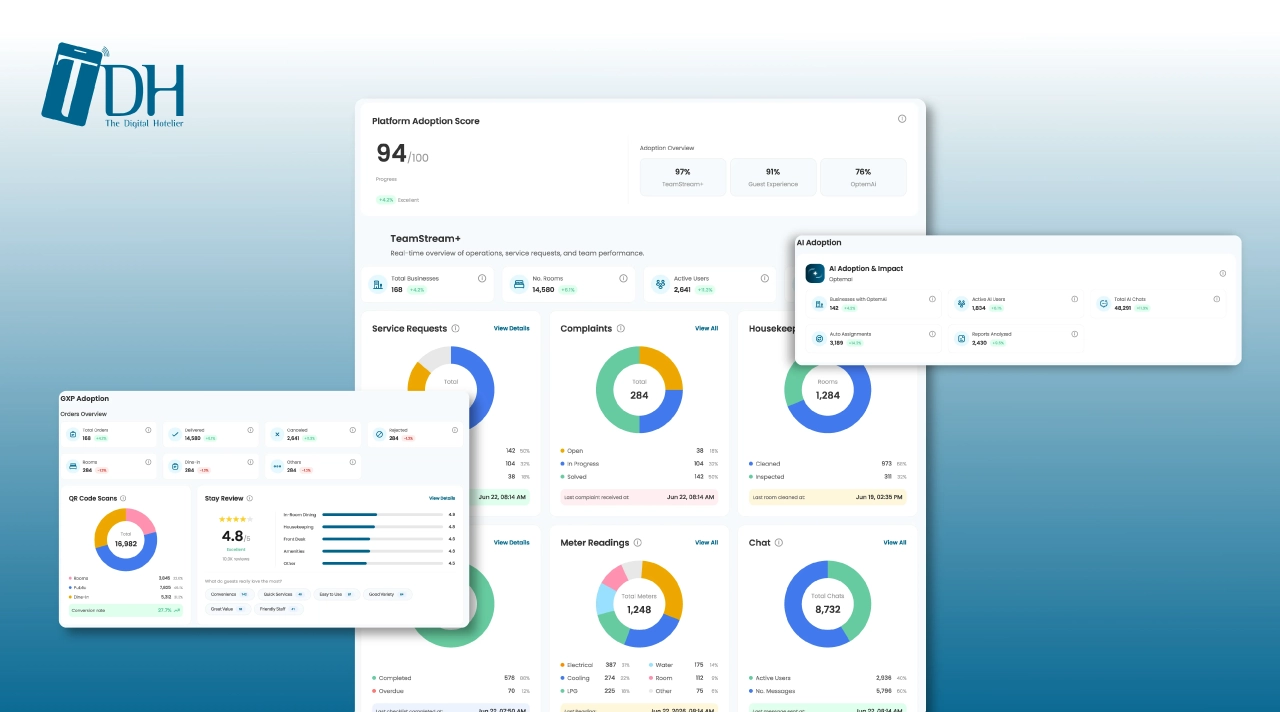
TeamStream+ pulls that into a single complaints report, with a breakdown of the root causes behind recurring issues and a clear view of how many cases are genuinely resolved against how many are still open. The same report can be read by OptemAi, the operations agent inside TeamStream+, which looks across the live complaint data, points out what is rising and what is repeating, and can suggest where to act or draft a reply.
It does not forecast anything. It reads what your own operation is already telling you, faster than a person scrolling through tickets ever could.
How to Build a Recovery Process That Actually Closes the Loop
A recovery process works when every failure gets caught, sent to the team that owns the fix, resolved, confirmed, and recorded, and when the people on the floor have enough authority to act in the moment. Put plainly, the loop has to close. Most hotels run an open loop that stops at the apology.
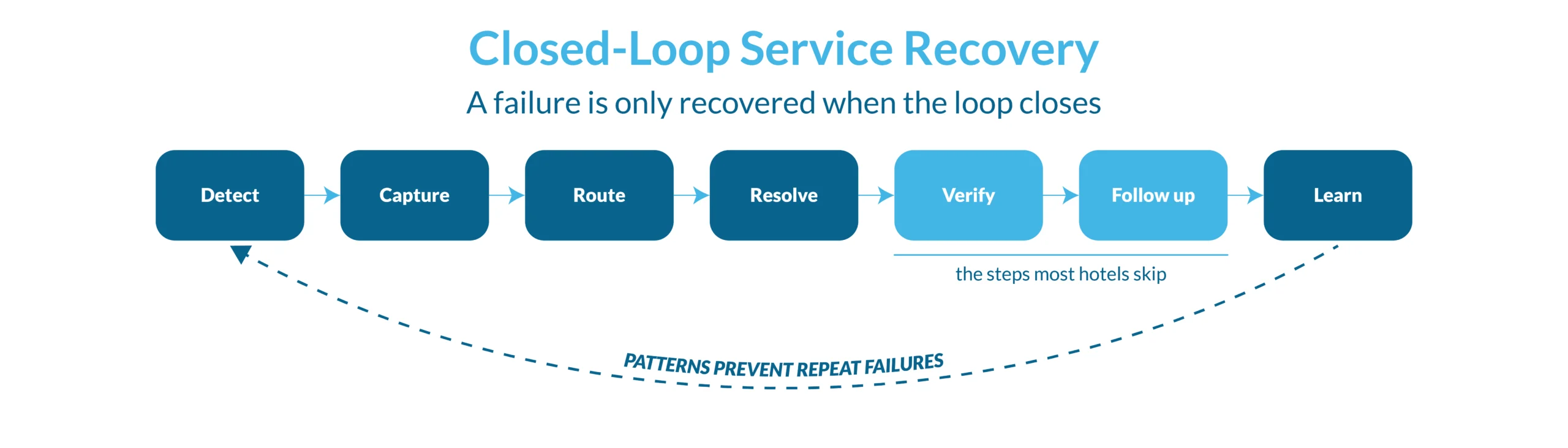
A failure is only recovered when the loop closes. Most hotels stop before Verify and Follow up.
It starts before the guest notices anything is wrong. A good operation catches a lot of service failures proactively, while they are still invisible to the guest.
A small example from our own platform: housekeeping and maintenance teams use TeamStream+ to log hot and cold water temperatures in guest rooms as a daily routine, ahead of the evening shower rush. If a reading is off, the team corrects it before a single guest turns a tap and gets cold water.
Water temperature is just one case. The same logic applies anywhere a routine check can surface a fault early, like a maintenance issue flagged on a checklist before the room is ever sold. Every failure you fix before the guest experiences it is a recovery you never had to perform.
When a failure does reach a guest, the next thing that matters is capture. The complaint has to get into the system the instant it surfaces, from whoever is standing there. From there it routes to the team that owns the fix, with an owner and a clock attached, instead of being relayed by word of mouth.
Guests can flag issues themselves, too, which is often how you catch a failure before it ever becomes a complaint. Guest-Journey, the app-less guest experience platform, lets a guest submit a request from a QR code in the room or anywhere on the property, with nothing to download, whether that is a housekeeping need, a maintenance issue, or something else wrong with the room.
The request lands as a task with the department that owns it, so the team can put it right while the guest is still on site. A frustration the guest might otherwise have swallowed and saved for a review becomes a task your team closes the same day.
Then comes the part the industry skips: confirming the loop is actually closed. Resolution is not a staff member marking it done. It is verifying the fix held, and checking back with the guest before they leave, so you find out in person, not in a review, whether they are satisfied. When the issue is serious enough, a follow-up from management at checkout is what seals it.
One honest note on timing, because hotels get this wrong in the other direction too. Catching a failure during the stay is the goal, but a missed window is not a lost cause. If you only find out after the guest has gone, a sincere, real recovery still works, late.
Reaching out, owning it, and making it right after checkout will not always win the guest back, but it beats silence every time, and it changes the public review more often than you would expect. Late recovery is weaker than in-stay recovery. It is far stronger than none at all.
What Closing the Loop Does for Your Reviews and Your Revenue
The return on all of this is measured in fewer bad reviews, and in the bookings and rates that bad reviews quietly cost you. A failure you catch and close before checkout is a one-star review that never gets written.
And when a low rating lands, treat it as a trigger, not just a record. It is the cue for whoever owns that guest relationship to reach out, find out what went wrong, and, where it warrants it, open a complaint so the fix gets tracked instead of forgotten.
In markets where a large share of demand comes through OTAs and review scores, the Maldives, Bali, and the Gulf’s luxury properties among them, that protection is worth real money, because a slipping score follows you into every future booking decision a traveler makes.
Recovery done inside the building protects the score. The score protects the rate. That is the business case, and it is a stronger one than hoping a well-handled apology makes someone love you a little more.
Service recovery is an operations problem wearing a customer-service costume. The apology is the visible ten percent. The ninety percent that decides whether a guest comes back is whether the failure got caught, routed to someone who could actually fix it, confirmed resolved, and followed up before the guest walked out the door. That is the general manager’s job as much as anyone’s.
The hotels that win at this are not the ones with the warmest scripts. They are the ones who closed the loop. If you want to see how The Digital Hotelier helps your team catch failures earlier, route them to the right people, and confirm they are genuinely resolved, book a demo and we will walk through it with your operation in mind.
Frequently Asked Questions
How fast should a hotel resolve a guest issue?
As fast as the issue allows, and always with an acknowledgment straight away, even when the actual fix takes longer. The speed of the acknowledgment matters as much as the speed of the repair. A guest who knows you are on it will wait far more patiently than one left wondering whether anyone heard them.
Who should own a guest complaint once it is logged?
The department that can actually fix it, not the person who first heard it. The front desk often takes the complaint, but a maintenance or housekeeping problem needs an owner inside that team, with a clear deadline, so it does not stall in the handoff between departments.
What is the difference between service recovery and complaint management?
Complaint management deals with the problems guests raise out loud. Service recovery deals with service failures whether or not the guest says anything, including the silent ones you catch yourself before they ever turn into a complaint. Complaint management is one piece of service recovery, not the whole of it.
Sources Referenced
Hart, C. W., Heskett, J. L., and Sasser, W. E. (1990). “The Profitable Art of Service Recovery.” Harvard Business Review, 68(4), 148–156. hbr.org
de Matos, C. A., Henrique, J. L., and Rossi, C. A. V. (2007). “Service Recovery Paradox: A Meta-Analysis.” Journal of Service Research, 10(1), 60–77. sagepub.com
Coyle, J., Coyle Hospitality Group. “The New Service Recovery Paradox: Step It Up With Follow-up” (11,000+ data points across 525 upscale hotel visits). coylehospitality.com
Esteban Kolsky, ThinkJar — customer-experience research on unvoiced customer dissatisfaction.