



Key Takeaways:
- Most hotel PM programs look fine on paper and break down in practice: when the Chief Engineer is off, when every room is sold, or when a task gets handed over verbally at shift change.
- You don’t need a complete asset list to start. Begin with the assets that would hurt most if they failed, and add the rest as you go.
- Manufacturer intervals are a baseline. A hotel’s HVAC runs around the clock, so the spec sheet is where you start, not where you stop.
- Every recurring task needs someone who owns it and someone who covers for them.
Expect the first real frequency calibration toward the end of your first 90 days. That’s when there’s enough data to see what needs adjusting.
Most hotel PM programs fail before they produce a single result. Not because the concept is wrong, but because the program was built the way generic guides tell you to build it: start a spreadsheet, list your assets, set some recurring tasks, and call it done.
What those guides skip is the part that actually matters. Who runs the program when the Chief Engineer is off? What happens to a scheduled inspection when all 200 rooms are occupied? How do you know, six months in, whether your frequencies are right or wildly miscalibrated?
This guide is about building a hotel PM program that functions as an operational system, not just a document.
For context on why preventive maintenance matters financially and operationally before you build the program, see why hotel preventive maintenance matters.
What is a hotel preventive maintenance program?
A hotel preventive maintenance program is a structured, scheduled approach to inspecting and servicing building systems and equipment before they fail. It covers every part of the property, from guest rooms and HVAC infrastructure to life safety systems and water hygiene. It defines what gets inspected, how often, who does it, what the procedure is, and how completion is tracked.
It is the alternative to reactive maintenance, where work only starts after something has already failed or started affecting service. In the UK, the Gulf and many international hotel operations the same practice is called Planned Preventive Maintenance, or PPM, and tender documents in those markets will often use that term.
Why Do Hotel PM Programs Fail?
Before getting into the build, the most common failure modes are worth naming directly, because every step in this guide is designed around one of them.
- The “exists on paper” problem. A checklist in a folder is not a PM program. Tasks without tracking cannot be verified. Tasks without a timestamped record fail brand audits, even when the work itself was completed.
- The occupancy scheduling conflict. Hotels cannot shut down for maintenance. A 250-room property at 80% occupancy has no property-wide downtime window, room access changes every day, and programs that ignore this get overridden by operations within weeks.
- The shift handoff gap. A task that opens on day shift and does not close before handoff has to reach the evening team with full context. In properties where handoffs happen verbally or through sticky notes, it disappears. This is a system design problem, not a staffing one.
- Frequencies set once and never recalibrated. Manufacturer service intervals are built on general usage assumptions, and a hotel’s duty cycle can differ from them considerably. A fan coil running 24/7 through a GCC summer can justify more frequent filter inspection or cleaning than a generic baseline.
Step 1: Build Your Hotel Asset Inventory
You cannot schedule maintenance for assets you have not cataloged. The asset register is the foundation of everything else.
What to Capture for Each Asset
For each asset, record the following:
- Asset name and type
- Location (building level, room or area, asset tag ID or QR code)
- Make, model, and serial number
- Installation date or estimated age
- Rated capacity or specification (where relevant)
- Responsible service contractor for specialist maintenance (elevators, fire suppression, gas systems)
Asset Categories a Hotel PM Program Covers
| Category | Key Systems |
| HVAC and climate | Chillers, AHUs, FCUs, RTUs, cooling towers, BMS controls |
| Domestic water | Boilers, DHW circulation pumps, calorifiers, storage tanks |
| Electrical infrastructure | Generators, ATS panels, distribution boards, UPS systems |
| Life safety | Fire suppression, smoke detection, emergency lighting, elevator recall |
| Guest room assets | PTAC units, plumbing fixtures, in-room technology, access control |
| Public areas and amenities | Pool plant, gym equipment, spa systems, kitchen extraction and refrigeration |
| Building envelope | Roofing, facade glazing, drainage, BMU systems (where applicable) |
| BOH and support | Laundry equipment, service elevators, parking CO ventilation, waste compactors |
Do not try to build a perfect inventory before starting. Start with what you have. A partial inventory that gets maintained is more useful than a complete one that takes three months to build and is already stale by the time it’s done.
Step 2: Score Your Assets by Criticality
This is the step most PM guides either skip or reduce to a vague tier label. In a hotel specifically, criticality scoring has to account for four dimensions that are distinct from how you would score assets in an office building or industrial facility.
The Four Dimensions That Matter in Hotels
- Guest impact
What happens to an in-house guest if this asset fails? HVAC failure in a guest room on a hot night generates an immediate complaint, potential compensation, and a negative review. A broken ceiling fan in the staff break room generates none of those consequences. - Revenue impact
Does failure take a room out of sellable inventory? An out-of-order room is a direct revenue loss equal to the ADR for every night the room is offline, before lost F&B and ancillary spend. - Safety and compliance risk
Does failure create a safety hazard or regulatory violation? Fire suppression, emergency lighting, elevator recall, and legionella-relevant water systems all sit in this category. A failure here is not just an operational problem. It is a liability one. - Recovery time
How long does it take to restore the asset after failure? An elevator requiring a specialist contractor with a 48-hour lead time is more critical than an ice machine that can be replaced the same day.
The Three-Tier Hotel Criticality Framework
| Tier | Definition | Examples | PM Treatment |
| Tier 1: Critical | Guest-facing failure or safety/compliance risk | Guest-room HVAC, elevators, domestic hot water (DHW), fire detection, pool plant, electrical distribution | Closest monitoring, supervisor sign-off on compliance-critical tasks, shortest response SLA |
| Tier 2: Operational | Back-of-house impact or delayed guest impact | Kitchen refrigeration, laundry, service elevators, mechanical plant, parking CO ventilation | Regular scheduled maintenance, documented completion |
| Tier 3: Low criticality | Inconvenient but not immediately impactful; run-to-failure acceptable | Staff area fans, non-safety decorative lighting, BOH small appliances | Visual inspection during area walkthroughs only |
Score every asset against these four dimensions before assigning a tier. An asset that scores high on guest impact almost always lands in Tier 1, regardless of what type it is.
Step 3: Set Your PM Schedule
The PM schedule is where the frequencies get set. Regulation, manufacturer guidance and brand requirements set the baseline. Operating conditions and failure history show where the interval needs adjusting. Criticality decides where that calibration effort goes first, whether an asset needs dedicated PM at all, and how closely the work is supervised. The most common mistake is applying manufacturer-recommended intervals uniformly across all assets, regardless of how they are actually used.
How to Set Frequencies (Without Just Copying the Spec Sheet)
For Tier 1 assets, start with the manufacturer-recommended interval, then adjust based on:
- Actual usage load (a hotel HVAC system runs 24/7, often a heavier duty cycle than a generic service interval is built around)
- Environmental conditions (coastal salt air, high humidity, or desert dust all accelerate component wear)
- Asset age relative to expected service life. ASHRAE publishes service life data by equipment type, and the figures vary widely. Assets in the later part of their expected service life usually need tighter inspection cycles.
For Tier 2 assets, manufacturer intervals are a reasonable starting point. Adjust after the first 90-day cycle if the data shows issues arising before or well after the scheduled inspection.
For Tier 3 assets, dedicated PM tasks are not required. Include them in general area walkthroughs.
Example Frequencies by Tier
Planning examples only; brand standards and manufacturer requirements take precedence. Formal inspection and testing of regulated systems (fire protection, emergency power, elevators, pressure plant and water systems) follows local code and service contracts, so it is not scheduled here.
| Frequency | Tier 1 Tasks | Tier 2 Tasks | Tier 3 Tasks |
| Daily | PTAC function checks in rooms turned over that day, plant room visual inspection, generator status check, pool water chemistry, fire alarm panel status check | Kitchen refrigeration temperature logs (HACCP), service elevator function check | Not required |
| Weekly | Condition inspection of high-criticality HVAC | Laundry equipment check, BOH walkthrough | Not required |
| Monthly | Filter cleaning and moving parts service on continuous-duty equipment | Mechanical plant inspections, parking CO detector check | General area walkthrough |
| Quarterly | Comprehensive condition assessment | Contractor-led specialist inspections for Tier 2 systems | Visual inspection |
| Annual | Specialist contract-based assessments | Annual condition review | Not required |
The Occupancy Scheduling Constraint
Hotels have no shutdown window, which is why access rather than task duration is usually what breaks a schedule. We cover that constraint and what follows from it in the guide to hotel preventive maintenance. In practice, any task that requires a room offline or creates guest-facing noise has to be scheduled around actual occupancy patterns:
- Inspect guest rooms during the natural departure-to-arrival window
- Batch mechanical room and plant work to off-peak hours
- Run pool plant maintenance before or after pool operating hours
- Coordinate with reservations before scheduling any room-specific Tier 1 work
At properties running continuous PM cycles, sold-out nights produce zero PM rooms. The booking calendar does not pause the maintenance schedule. It displaces it.
Recurring Tasks vs Event-Triggered Checks
Not every task in the program belongs on the recurring PM calendar. Some are planned checks triggered by specific events:
- Pre-season HVAC start-up inspection before peak demand
- Post-renovation systems check before rooms return to sellable inventory
- Water hygiene flush protocol after extended room vacancy (UK HSE guidance, HSG274, calls for flushing outlets that are not used at least weekly; under ASHRAE 188 the threshold is set by the property’s water management program)
- Post-power-outage generator and UPS check after any mains failure event
They sit alongside the preventive schedule rather than inside it, and they still need to be in the program as named tasks, with a clear condition that activates them.
For the full property-wide task list organized by area and frequency, see the hotel preventive maintenance checklist.
Step 4: Assign Ownership and Write Field-Ready SOPs
A schedule without a named owner is a wish list.
Ownership in a Small Engineering Team
In most mid-scale hotels, the engineering team is two to five people. The typical ownership structure looks like this:
- Chief Engineer / Engineering Manager: Owns the program, runs the daily exception review, coordinates specialist contractors
- Senior Technician: Executes Tier 1 daily and weekly tasks, covers the CE when off-property
- Technician(s): Execute Tier 2 scheduled tasks, handle reactive work orders
Each recurring task should have a designated role and a named backup. This does not require extra headcount. It requires the system to know who the backup is so that absence does not create a gap.
What Makes a Hotel PM SOP Usable in the Field?
For routine field checks, the test is simple: a technician who has done the task before should be able to run through it in under two minutes without referring to anything else. Safety-critical work, such as isolation and lockout, keeps its full procedure.
A field-usable SOP has:
- Three to five clear steps for a routine check
- The specific procedure for the specific asset (not a generic “inspect HVAC” instruction)
- A photo reference showing what a failed or worn component looks like
- The tool or materials required
- The escalation path if an issue is found
A six-page manual is documentation. A field SOP is a tool. The distinction determines whether your technicians use it or ignore it.
Step 5: Launch the First Cycle and Calibrate
Do not try to build the full program before running any of it. The fastest path to a functional PM program is a working pilot on your highest-criticality assets, run for 30 to 60 days, then reviewed and expanded.
The 90-Day Hotel PM Launch Plan
| Phase | Timeline | Actions | Output |
| Phase 1: Foundation | Days 1 to 30 | Complete asset inventory for Tier 1 assets. Score criticality. Set frequencies. Assign ownership. Write SOPs for the top 10 highest-criticality assets. Start tracking completions digitally. | Tier 1 program running with documented completions |
| Phase 2: Expansion | Days 31 to 60 | Add Tier 2 assets. Bring all engineering staff through assigned SOPs. Review first 30 days of completion data: what is getting done, what is being skipped, and why. | Full asset register complete. First gap analysis done. |
| Phase 3: Calibration | Days 61 to 90 | Adjust frequencies based on first-cycle data. Add Tier 3 assets to area walkthroughs. Build the first monthly compliance report for the GM or ownership. | Calibrated schedule. First ownership-ready report. |
Which Three Metrics Show Whether a Hotel PM Program Is Working?
At the end of 90 days, three numbers tell you more than any qualitative review:
| Metric | Working reference | What It Tells You |
| PM completion rate | Above 85%, as an internal working target | Are tasks being executed on schedule? |
| Planned-to-reactive ratio | 70–80% planned, as an internal goal rather than a published standard | Are you ahead of failures or reacting to them? |
| Maintenance-related guest complaints | Reduction vs prior 90 days | Is the program actually protecting the guest experience? |
A functioning preventive maintenance program cuts maintenance costs by an estimated 12 to 18 percent on average, according to the U.S. Department of Energy’s Federal Energy Management Program, and properties starting from a purely reactive position typically see more than that. Moving recurring, preventable failures into planned work pushes the operation in that direction. A property sitting well below half planned is paying for that gap in emergency labor and lost rooms.
What Separates a PM Program That Runs from One That Exists on Paper
1. A single daily visibility point
Someone reviews completion data every morning. Not a weekly report, a daily view. This is not a surveillance mechanism. It is how problems get caught before they become failures. A Tier 1 task that was skipped yesterday needs to be rescheduled today, not discovered during a brand inspection next quarter.
2. A closed-loop documentation trail
Every completed task generates a record: who did it, when, what was found, and what action was taken. This matters beyond pure maintenance logic for two reasons:
- Brand inspections typically require documented evidence of PM completion, not verbal assurances. Properties with structured records can produce task completion logs and inspection records with photo attachments on request.
- When equipment fails despite PM, the documentation shows what was done and when. That matters for warranty claims and insurance.
3. Recalibration built into the calendar
Schedule a quarterly review of the program itself: are frequencies still right, are there assets that should move tiers, have any equipment changes made existing SOPs inaccurate? Programs that treat the initial setup as permanent calcify. The first version of a PM schedule is a hypothesis. The data from running it is what confirms or revises it.
Running the Program with TeamStream+ and OptemAi
Spreadsheets and paper logs work for small properties with limited assets. Both fail predictably once the operation scales, not because the people stop caring, but because the system depends entirely on individual discipline rather than designed workflow.
TeamStream+ is built to run the exact program this article describes. The schedule you defined in Step 3 runs automatically in digital checklists, with tasks assigned to the right role and set to recur at the right frequency without manual intervention.
The SOPs from Step 4 are embedded directly inside each task, so the technician sees the procedure at the moment of execution, not in a separate document they have to locate. Completion is time-stamped, with photo attachments where the task calls for them, which creates the closed-loop audit trail that Step 5 identifies as the difference between programs that persist and programs that quietly collapse.
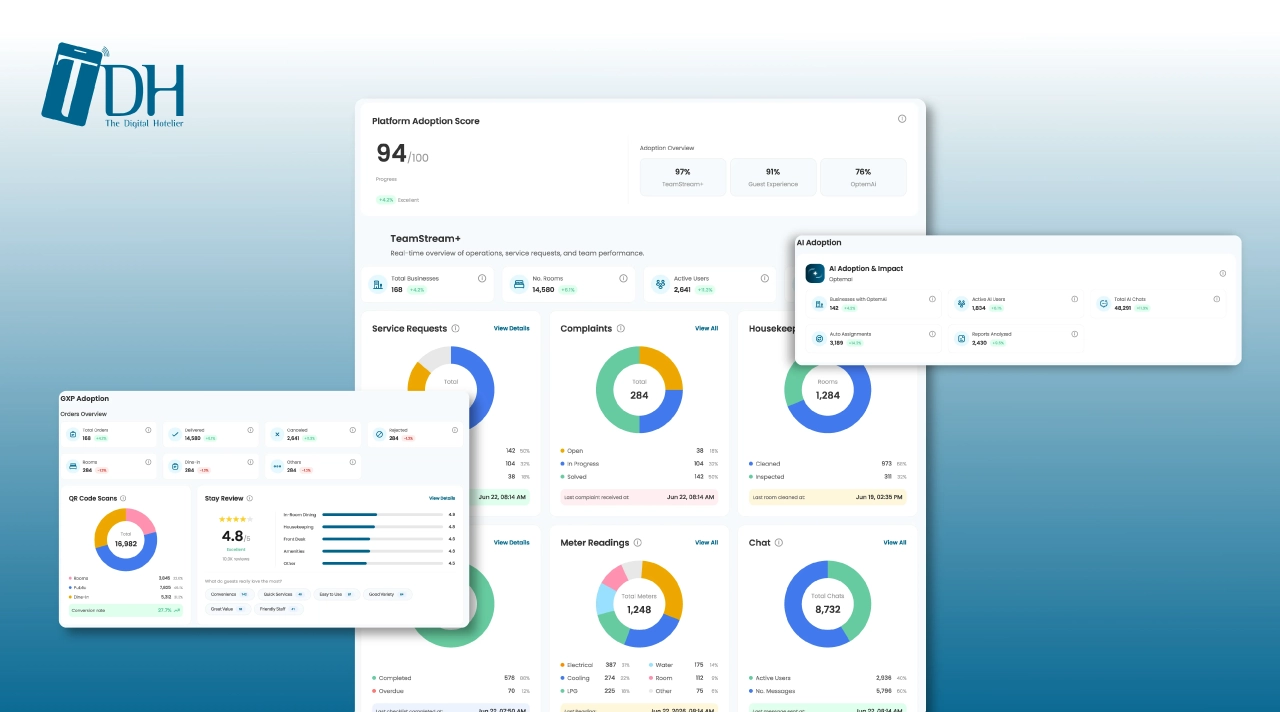
PM completion rates and overdue task visibility are tracked in real time on the maintenance reporting dashboard. The Chief Engineer does not need to pull a report.
Overdue Tier 1 tasks escalate automatically, so missed critical work stays visible.
OptemAi, the AI agent built into TeamStream+, makes the operational data queryable. Instead of reviewing stacked reports to find where the program has gaps, you ask directly:
- “Which PM tasks have the lowest completion rates this month?”
- “What maintenance issues were flagged in guest rooms this week?”
OptemAi reads the data and returns the answer. The calibration review you schedule every quarter in Step 5 becomes a conversation, not a reporting exercise.
For what to look for in hotel PM software, see the hotel preventive maintenance software guide.
Start with a Strong Foundation
If you are evaluating whether your current maintenance approach has structural gaps, the most useful first step is an honest audit of what you are currently tracking, how you are tracking it, and where coverage is incomplete.
The Digital Hotelier (TDH) is ready to help. If you want to see exactly how our platform can benefit your operation and handle your specific property needs, let’s connect.
Book a Demo with The Digital Hotelier
Frequently Asked Questions
How long does it take to build a hotel PM program from scratch?
A working program for Tier 1 assets can be running within 30 days if the asset inventory exists. The full program covering all three tiers, with SOPs, assigned ownership, and calibrated frequencies, typically takes 60 to 90 days to build and run through a first complete cycle. The 90-day mark is also when you have enough data to do the first meaningful frequency calibration.
What is the right planned-to-reactive maintenance ratio for a hotel?
There is no published hotel standard for this ratio. Around 80% planned is widely quoted as a rule of thumb. Treat 70 to 80 percent as an internal reference point, more useful as a direction of travel than as a target you have failed to meet. What it does show reliably is the shape of your operation: a property sitting well below half planned is in a reactive cycle that is more expensive, less predictable, and harder to break without a deliberate structural change. Tracking this ratio monthly is the fastest way to know whether the program is gaining ground or losing it.
Does a small hotel need the same PM program structure as a large one?
The structure is the same. The scope is different. A 300-room full-service property has more assets, more complex systems, and a larger engineering team, but the same criticality scoring logic, frequency-setting principles, and documentation requirements apply. A 60-room independent hotel with a single part-time engineer applies the same framework to a shorter asset list. The criticality scoring is particularly valuable at smaller properties because it prevents over-maintaining low-risk assets with very limited labor.
How does a hotel PM program affect brand inspection scores?
Brand quality assurance reviews typically ask for documented evidence of PM completion. Properties with structured, digitally tracked programs can produce task completion records, inspection records with photo attachments, and compliance calendars on request. Paper-based programs can produce it too, but keeping those records complete and consistent gets harder as the asset count and team grow. Maintenance deficiencies are a frequent source of QA score deductions, and a structured PM program is the most direct way to address them systematically.
What guest room PM tasks should be covered in a hotel PM program?
Guest rooms require dedicated PM coverage because room failures directly affect guest experience and pull inventory from sellable status. The key categories are HVAC and climate control, plumbing and hot water, electrical and lighting, access control and in-room technology, furniture and fixture condition, and bathroom fixtures.
Which HVAC tasks are most critical in a hotel PM schedule?
HVAC is typically one of the highest-criticality system categories in a hotel, particularly in markets with extreme heat or humidity. Core HVAC PM tasks include filter cleaning and replacement, coil inspection and cleaning, refrigerant level checks, belt and bearing inspection, thermostat calibration, and condensate drain clearing. Expected service life varies widely by equipment type, and without consistent maintenance, failures tend to arrive earlier.
Sources Referenced
American Society of Heating, Refrigerating and Air-Conditioning Engineers (ASHRAE). ASHRAE Handbook, HVAC Applications (Owning and Operating Costs chapter), and the ASHRAE Service Life and Maintenance Cost Database. ashrae.org
American Society of Heating, Refrigerating and Air-Conditioning Engineers (ASHRAE). ASHRAE Standard 188: Legionellosis: Risk Management for Building Water Systems. ashrae.org
Health and Safety Executive (HSE). HSG274 Part 2: The control of legionella bacteria in hot and cold water systems. hse.gov.uk
U.S. Department of Energy, Federal Energy Management Program (FEMP). Operations & Maintenance Best Practices: A Guide to Achieving Operational Efficiency, Release 3.0. energy.gov